
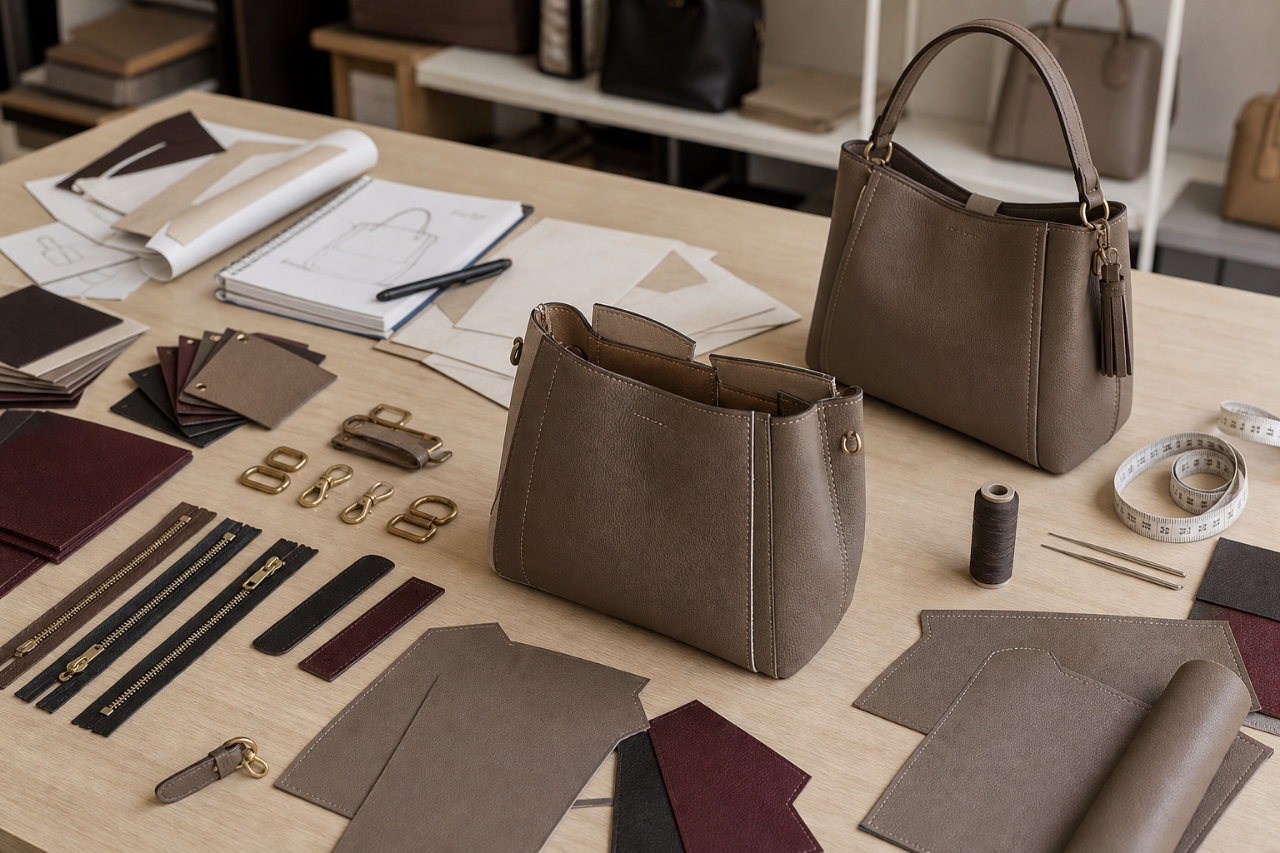
When a European brand sends the same reference bag to three Guangzhou factories, the three quotes that come back can differ by 30% or more. That gap confuses many first-time buyers. In most cases the factories are not guessing—they are pricing different interpretations of the same bag. Understanding what a quote is made of turns that confusion into a set of clear questions.
The five building blocks of a handbag quote
Every ex-factory handbag price, however it is presented, is assembled from the same five blocks. The proportions shift with the style, but the structure does not.
Outer material and lining
Usually the largest block—often 30–45% of the total. It covers the PU, vegan or genuine leather, the lining, reinforcement materials and the cutting loss that comes with real-world panel shapes. Material grade, thickness, finish and supplier minimums all move this number.
Hardware and trims
Zips, locks, rings, buckles, chains, magnetic closures, logo plates and decorative fittings. Standard fittings may add little; custom-plated or logo-engraved hardware can rival the material cost on a small order, because component suppliers apply their own minimums and mould charges.
Labour
Cutting, skiving, stitching, edge painting, assembly and finishing. Labour follows the operation count: a simple tote and a structured bag with piping, multiple compartments and hand-finished edges can differ by a factor of two or three in work minutes per piece.
Overhead, loss and packaging
Factory overhead, quality control, the normal defect and material-loss allowance, plus dust bags, tissue, hangtags, polybags and export cartons. Individually small, together typically 10–20% of the quote.
Margin
The factory's profit, and the block that absorbs risk: currency movement, material price changes and the cost of remaking defective units. An unrealistically low margin at quotation stage often reappears later as quality shortcuts or mid-order price renegotiation.
Why two factories quote different prices for the same bag
Price gaps between factories are rarely random. They usually trace back to one of these differences:
Material interpretation
"PU leather" describes a category, not a material. One factory may price a stock market PU at a few yuan per metre; another may price a thicker, REACH-aligned article from a documented mill. Both quotes say "PU".
Construction assumptions
Without a tech pack, each factory guesses the interior build: reinforcement, pocket count, edge finish, stitch density. A factory assuming a premium construction will quote higher—and may be the one that actually understood your market.
Quantity and MOQ position
Unit prices fall as setup and material-lot costs spread over more pieces. A quote at 300 pieces and a quote at 1,000 pieces are not comparable without knowing which quantity each factory assumed.
What is included
Some quotes include sampling, custom hardware moulds, testing support and export packaging; others list them separately or leave them out entirely. The cheapest number is often the one with the most exclusions.
Factory positioning
A workshop competing on price and a development-led factory serving European brands have different cost structures, quality systems and margins. Their quotes describe different products, even for the same reference image.
There is also a timing factor that brands often miss. Material and hardware prices in the supply chain move with seasons and raw-material markets, so a quote has a practical validity window—commonly two to four weeks. A number received in March and an order placed in June may need a fresh confirmation, especially for styles with metal-heavy hardware or genuine leather. Treat every quote as dated information, not a permanent price list.
How to compare quotes without comparing apples to oranges
The goal is not to find the lowest number—it is to find out what each number buys. A few working habits make quote comparison reliable:
Fix the specification first
Send the same tech pack—or at minimum the same reference images, material direction, dimensions, hardware list and colourway plan—to every factory. Quotes are only comparable when they price the same product.
Ask for a cost breakdown
A factory willing to separate material, hardware, labour and packaging gives you something to discuss. A single flat number gives you nothing to work with when the price needs to move.
Request tiered quantities
Ask for prices at two or three quantities, such as 300, 500 and 1,000 pieces. The steps reveal how much of the quote is fixed setup cost—and what a larger commitment would actually save.
List the exclusions in writing
Confirm whether the price covers sampling, moulds, custom hardware development, testing documentation, special packaging and pre-shipment inspection. Put the answers in the same email thread as the quote.
Share a target price early
An honest target retail or unit price lets the factory propose concrete trade-offs—material grade, hardware swaps, construction simplifications—instead of guessing. It turns negotiation into engineering.
One final habit separates experienced sourcing teams from first-time buyers: they treat the quotation stage as a test of the factory, not just of the price. How a factory reads your brief, which questions it asks before quoting, and whether its breakdown survives a detailed review tells you more about the coming production experience than the number at the bottom of the page.
What to send for an accurate number
- Reference images or a tech pack with dimensions
- Material direction: stock PU, genuine leather or certified alternatives
- Hardware and branding requirements, including logo application
- Colourways, sizes and quantity per style
- Target retail price or target unit cost
- Packaging, testing and compliance requirements for your market
Questions brands often ask
Why does a handbag sample cost more than the bulk unit price?
A sample carries the full development work of the style—pattern making, material sourcing in small quantities, cutting by hand and repeated corrections—spread across one or two pieces instead of hundreds. The bulk price only works because that setup cost is divided across the whole order.
Should a brand share its target price with the factory?
Yes—an honest target price makes the conversation faster and more practical. With a target, the factory can propose specific trade-offs in material grade, hardware and construction instead of guessing, and both sides can see quickly whether the project is viable.
Does the lowest quote usually save money?
Not reliably. A quote that is far below others usually means a different material grade, simpler construction, excluded services or a plan to recover margin later. Compare what each price includes before comparing the numbers themselves.